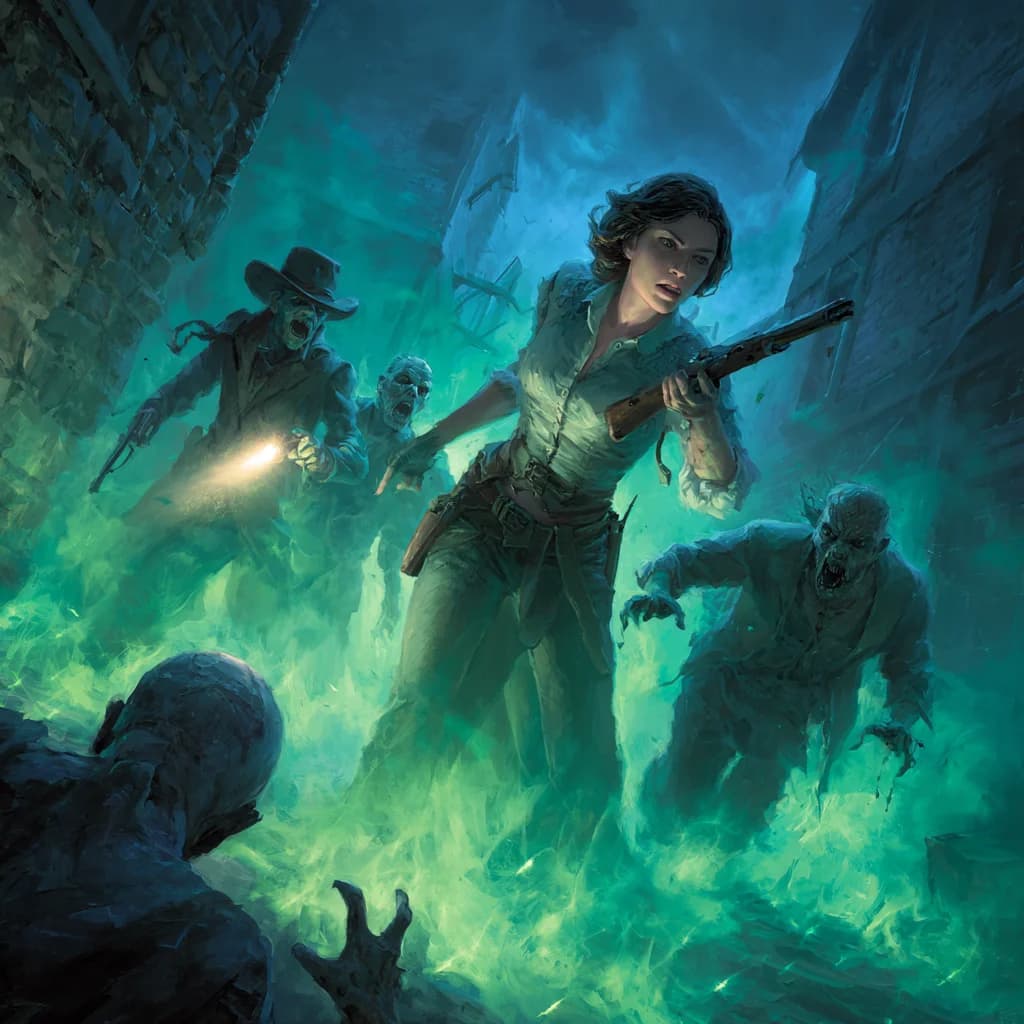
Hunter: The Reckoning 5th Edition
How to play Hunter: The Reckoning 5th Edition
A fast, practical overview. Hunter: The Reckoning 5th Edition is a tabletop RPG where you play as ordinary humans who have been "Imbued" with supernatural awareness, allowing you to see and hunt the monsters that prey on humanity. As part of the Vigil, you track your Conviction, manage your Edges, and work with your cell to protect the innocent.
Beginner checklist
Set your intent and approach (then pick the best dice pool).
Roll Attribute + Skill as a d10 pool; count successes on 6+.
Track harm, conditions, and what you risk when you escalate.
Track Conviction/Edges (and your drive) as the core pressure loop.
How rolls work
VTM V5 uses d10 dice pools: roll Attribute + Skill, count successes on 6+, and watch for criticals on 10s. Hunger dice add personal-horror volatility (messy criticals and bestial failures).
Build your pool (Attribute + Skill).
Roll d10s and count successes (6+).
Interpret 10s (critical) and Hunger outcomes (messy critical/bestial failure) as story-forward complications.
If Hunger dice contribute to a critical, the success is messy: you win, but the Beast shows.
Key facts
5 Creeds: Entrepreneurial, Faithful, Inquisitive, Martial, Underground
Edge system: Supernatural abilities granted by the Imbuing
Conviction mechanics: Fuels Edges, represents commitment to Vigil
Cell system: Hunters work in groups for safety
Monster hunting focus: Investigate, prepare, hunt
Human vulnerability: Still human, powerful but fragile
Derived stats: Health, Willpower, Desperation, Danger, Despair
Play examples
Hunters are still human
If you go toe-to-toe with something stronger, the cost is usually harm or collateral. The safer play is investigation, preparation, and teamwork.
Edges are your leverage
Edges are the tools that let you punch above your weight. Use them when it matters, then plan for the consequences and limits.
Common mistakes
Playing Hunters like superheroes.
Lead with investigation and preparation; choose direct fights when the leverage is real.
Holding Edges for a 'perfect moment'.
Use them to tilt scenes you actually care about, then deal with the fallout.
Character creation
Choose Concept and Creed
Pick a Drive (your personal motivation for the Hunt)
Distribute Attributes: assign values across all 9 attributes — one at 4, three at 3, four at 2, one at 1 (not divided by category)
Distribute Skills: choose one template — Jack of All Trades (1 at 3, 8 at 2, 10 at 1), Balanced (3 at 3, 5 at 2, 7 at 1), or Specialist (1 at 4, 3 at 3, 3 at 2, 3 at 1)
Choose 3 Skill Specialties
Assign Edges: choose 2 Edges and 1 Perk, or 1 Edge and 2 Perks
Choose Backgrounds (7 dots), Merits, and Flaws
Pick Touchstones and determine Desperation trigger
Calculate derived traits: Health, Willpower, Desperation
Attributes
What to track during play
What to open next
Prefer definitions? Browse terms in the Hunter glossary.
FAQ
What are Creeds in Hunter 5e?
Creeds are philosophical approaches to the Vigil, the mission to hunt monsters. Entrepreneurial hunters are pragmatic networkers who leverage resources and connections. Faithful hunters believe in a higher purpose driving their mission. Inquisitive hunters seek truth and knowledge about the supernatural. Martial hunters are disciplined warriors who fight with precision. Underground hunters are street-smart survivors who operate in the shadows. Each Creed offers different Edges and roleplay opportunities.
How does Conviction work in Hunter 5e?
Conviction represents your commitment to the Vigil and fuels your Edges. You start with 3 Conviction. You spend Conviction to activate Edges (supernatural abilities). Conviction can be lost through failure, witnessing horrors, or losing hope. You regain Conviction through success, protecting innocents, or achieving goals. Maintaining high Conviction is essential for effective monster hunting.
What are Edges in Hunter 5e?
Edges are supernatural abilities granted by the Imbuing, the moment you became aware of monsters. Each Creed has unique Edges that reflect their approach to hunting. Examples include Entrepreneurial's resource management Edges, Faithful's conviction-based Edges, Inquisitive's investigation Edges, Martial's combat Edges, and Underground's stealth and survival Edges. Edges cost Conviction to use and represent your character's supernatural awareness and abilities.
What is a cell?
A cell is a group of Hunters who work together. Cells provide safety, support, and shared resources. Hunters are vulnerable alone. Monsters are powerful and dangerous. Working in a cell allows Hunters to share information, coordinate hunts, and protect each other. Cells typically have 3-6 members.
How powerful are Hunters compared to monsters?
Hunters are still human, powerful but vulnerable. They can see monsters and use Edges, but they're not superhuman. Hunters rely on investigation, preparation, and teamwork to survive. Direct confrontation with powerful monsters is usually fatal. The game emphasizes smart tactics over brute force.